
There are no items in your cart
Add More
Add More
| Item Details | Price | ||
|---|---|---|---|

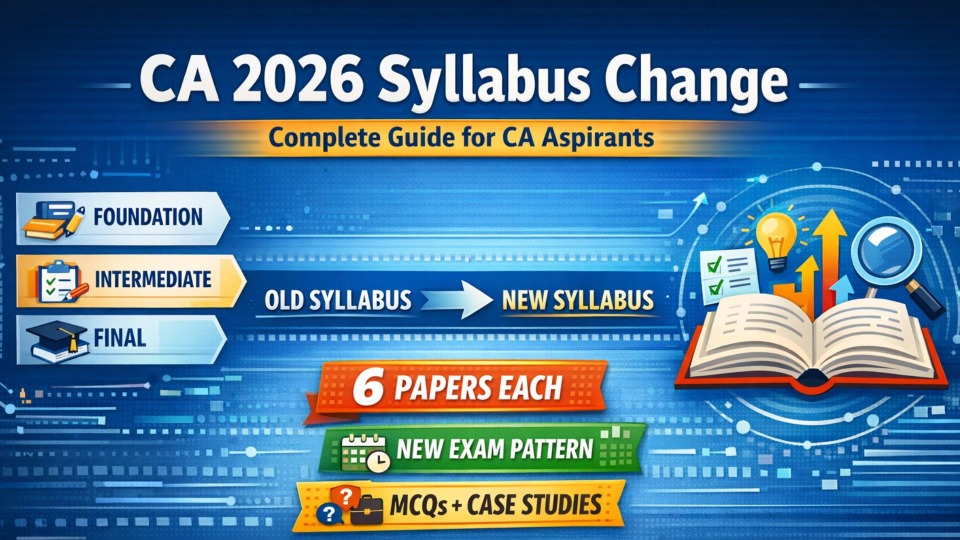
The journey to becoming a Chartered Accountant is undergoing a significant modern transformation. The Institute of Chartered Accountants of India (ICAI) has initiated the rollout of its 2026 syllabus reforms, aligning the CA course with the demands of a rapidly evolving, technology-driven, and globally connected business landscape. From the Foundation level to the Final stage, the revised structure focuses on shifting learning away from purely technical, theoretical, and rote-based methods toward a more practical, strategic, and application-oriented approach to real-world problem solving. Understanding these changes at every stage of your CA journey is crucial—whether you are just beginning or preparing for the final phase. Early familiarity with the new syllabus framework will help you navigate challenges more effectively, leverage emerging opportunities, and stay ahead as you progress toward becoming a Chartered Accountant.
Click on any batch to view details and enrol instantly!
Global accounting standards, technological advancements, and changing company models necessitate a curriculum that goes beyond theory to reflect real-world realism. With fewer papers, more linked subjects, more intelligent evaluation, and a shorter articleship time, ICAI's 2026 New Scheme of Education & Training seeks to modernize the process. In other words, more contemporary, quicker, and sharper.
Together, these changes go beyond a simple rescheduling of exams. They represent a fundamental shift in the CA journey itself, making it essential to adapt your study approach to match the evolving structure.
If you’re planning to appear for the Foundation exam under the 2026 scheme (January, May, or September sessions), the curriculum will consist of four papers:
Papers 1 and 2 will follow a subjective format, focusing on descriptive, theory-based answers. Papers 3 and 4 will be primarily objective in nature (MCQs) and will include a nominal negative marking for incorrect responses (for example, a deduction of 0.25 marks per wrong answer). This format favors candidates who can think quickly while maintaining accuracy.
Preparation tip: For objective papers, prioritize speed, precision, and regular practice. For subjective papers, focus on building strong conceptual clarity and presenting answers in a well-structured manner. Balancing both approaches in your study plan will be key to success.
The Intermediate level has been streamlined to six papers, reduced from the earlier eight-paper structure:
Group I
a) Advanced Accounting
b) Corporate & Other Laws
c) Taxation (Income Tax and GST)
Group II
a) Cost & Management Accounting
b) Auditing and Code of Ethics
c) Financial Management & Strategic Management
A key change to note is the explicit inclusion of Code of Ethics within Auditing and the addition of Strategic Management alongside Financial Management. These updates clearly indicate a shift in the syllabus toward ethical awareness, strategic decision-making, and future-ready thinking. The introduction of MCQs further reinforces this transition. Additionally, with fewer papers, each subject now carries greater importance, making focused and disciplined preparation essential. Your study schedule should be aligned accordingly—less number of papers allows for deeper concentration, not lighter effort.
Click on any batch to view details and enrol instantly!
At the highest stage, the Final level has also been restructured to six papers, reduced from the earlier eight-paper format. The papers are as follows:
Bottom line: The Final level is increasingly oriented toward applied problem-solving, professional judgment, and strategic decision-making, moving well beyond purely theoretical or textbook-based learning.
Click on any batch to view details and enrol instantly!
The introduction of the new CA syllabus effective from 2026 serves as a strong reminder that the profession is in a constant state of evolution. Success today is not merely about adapting to change, but about learning how to stay ahead of it. When approached with the right mindset, a clear plan, and consistent dedication to the craft, the uncertainty that comes with change can be transformed into a powerful opportunity for growth. Each revision, new requirement, and procedural shift offers a chance to refine your strategy, strengthen your conceptual foundation, and build greater competence and confidence. In a rapidly changing professional landscape, those who remain flexible, think strategically, and commit to continuous effort position themselves for long-term success. The future will favor individuals who prepare thoughtfully, think ahead, and use change as a stepping stone forward—rather than a reason to remain on the sidelines.
🚀 Ready to start your CA Journey?
Click the image or button above to explore our courses!
 Launch your Graphy