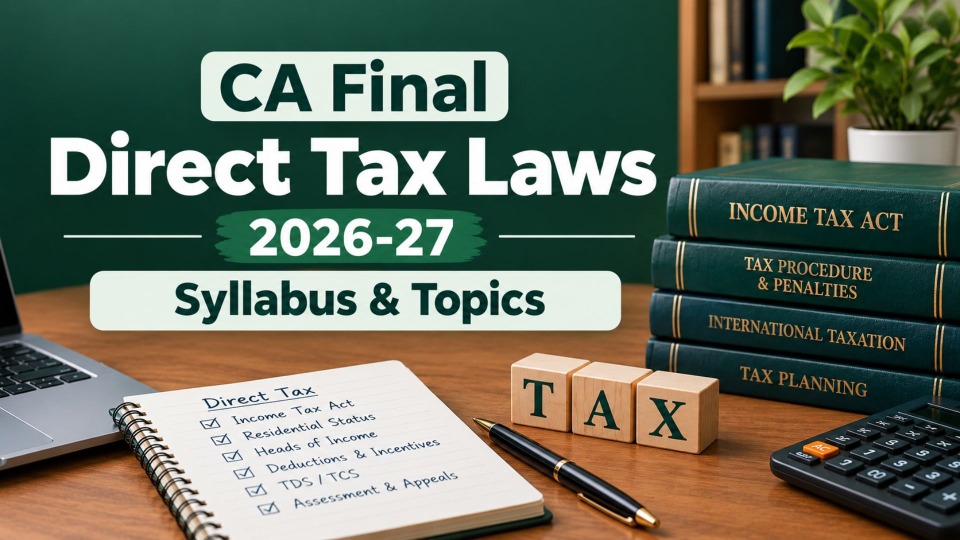
The implementation and interpretation of tax laws in real-world scenarios are covered in the Direct Tax Laws paper. The curriculum covers cross-border transactions and international taxation in addition to domestic taxation.

The paper is broken up into three sections and is worth 100 points. Comprehensive income-tax liability calculations and special provisions are included in Section I. Appellate procedures and tax administration are the main topics of Section II. International taxation, including transfer pricing, tax treaties, and BEPS, is covered in Section III.

You should be aware of the applicable Study Guidelines, pertinent changes, and the specified provisions for the 2026–2027 preparation cycle. You can organize your study timetable and allocate the proper amount of time to each area by using the section-wise weighting.

CA Final Direct Tax Laws 2026-27 Syllabus

The three portions of the syllabus deal with international taxation, tax administration, and domestic taxation. Each part has several topics that call for both conceptual comprehension and real-world application, and each has a predetermined weight.

Section I: Comprehensive Computation of Income-Tax Liabilities

Weightage: 40%-45%
The paper's overall weight is highest in Section I. It focuses on how businesses and other entities calculate their income-tax obligations.
The following topics are covered in this section:

  • Comprehensive computation of income-tax liabilities of companies and other entities
  • Alternative tax regimes under the Income-tax Act, 1961
  • General provisions for computation of total income
  • Computation of tax liability
  • Special tax regimes for companies and other entities
  • Tax planning for optimisation of tax liability
  • Special provisions relating to charitable and religious trusts and institutions
  • Provisions relating to political parties
  • Electoral trusts
  • Business trusts
  • Securitisation trusts
  • Investment funds
  • Other funds and trusts
  • Anti-avoidance provisions
  • Tax challenges arising from digitalisation
20%–23% of Section I's weight is given to the thorough calculation of businesses' and other entities' income-tax obligations. Special rules pertaining to trusts and institutions, anti-avoidance laws, and provisions addressing tax difficulties resulting from digitalization make up the remaining 20%–22% weight.

You should concentrate on comprehending how various provisions interact during tax computation when writing this section. For practical concerns, simply understanding specific provisions might not be enough.

Section II: Tax Administration and Appellate Mechanism

Weightage: 20%-30%

The administrative and procedural facets of direct taxes are covered in Section II. Provisions pertaining to appeals, revision, tax recovery, penalties, offenses, and tax audits are also included.
The main subjects are:

  • Deduction, collection and recovery of tax
  • Income-tax authorities
  • Assessment procedures
  • Appeals and revision
  • Dispute resolution
  • Provisions to counteract unethical tax practices
  • Taxation of undisclosed income
  • Taxation of undisclosed foreign income and assets
  • Penalties
  • Offences and prosecution
  • Miscellaneous provisions
  • Tax audit
You should be aware of the order in which tax administration processes are carried out. Instead of just stating a provision, questions may ask you to apply it to a particular circumstance.
Careful research is also necessary on the subjects of foreign assets and concealed income. Be mindful of these clauses' circumstances, applicability, and implications.

Section III: International Taxation

Weightage: 30%-35%
The CA Final Direct Tax Laws syllabus includes a substantial section on international taxation. The taxation of non-resident taxpayers and cross-border transactions is the main topic of this section.
This section comprises:

  • Taxation of cross-border transactions
  • Non-resident taxation under the Income-tax Act, 1961
  • Transfer pricing
  • Double Taxation Relief
  • Advance Ruling
  • OECD Model Tax Convention
  • UN Model Tax Convention
  • Fundamentals of Base Erosion and Profit Shifting (BEPS)
  • Application and interpretation of tax treaties
  • Latest developments in international taxation
Both the pertinent international tax ideas and domestic rules should be studied. Because it entails comprehending the connection between domestic tax law and treaty requirements, the application of tax treaties is very significant.
Another important topic in this part is transfer pricing. You want to comprehend the fundamental structure and how it applies to international transactions.

CA Final Direct Tax Laws Syllabus PDF

Throughout your preparation, you should have access to the required syllabus document. It can assist you in reviewing the subjects addressed in each part and determining any modifications relevant to your exam cycle.
Additionally, the syllabus allows for modifications in the event that an existing statute expires or is replaced by a new one. The Study Guidelines published for the applicable year may additionally contain specific inclusions and exclusions.

Download Syllabus

Important Points for CA Final Direct Tax Laws 2026-27

  • The paper carries 100 marks.
  • Section I carries 40%-45% weightage.
  • Section II has a weight of 20% to 30%.
  • Section III has a weight of thirty to thirty-five percent.
  • A significant portion of Section I is devoted to comprehensive income-tax computation.
  • Appeal procedures and tax administration are covered in Section II.
  • Section III deals with international taxation.
  • International taxation includes non-resident taxation and transfer pricing.
  • The curriculum includes the OECD and UN Model Tax Conventions.
  • Included are the foundations of BEPS.
  • The most recent advancements in international taxes are discussed.
  • Certain issues may be impacted by revisions to the Annual Finance Act.
  • Additions, deletions, inclusions, and exclusions may be specified in the study guidelines.
  • Legislative changes may have an impact on the examination's applicable provisions.
According to the syllabus, you must integrate practical application with conceptual comprehension. Prior to allocating your preparation time, you should comprehend the three sections' structure and relative importance. While practical and case-based questions can help you apply tax provisions to various situations, regular practice is helpful for computation-based areas.

Mentor Card
Meet Your Mentor

CA Vipul Dhall

CA Vipul Dhall is a first-attempt Chartered Accountant and All India Rank 43 in CA Finals, B.Com graduate from Hindu College, University of Delhi, he brings valuable corporate experience from PwC and Bharti Airtel, blending practical industry insights with a strong passion for teaching. With 6+ years of teaching experience, his mission is to inspire students to believe that the CA dream is achievable with the right guidance and discipline.

AIR 43
6+ Years
Explore my courses