There are no items in your cart
Add More
Add More
| Item Details | Price | ||
|---|---|---|---|

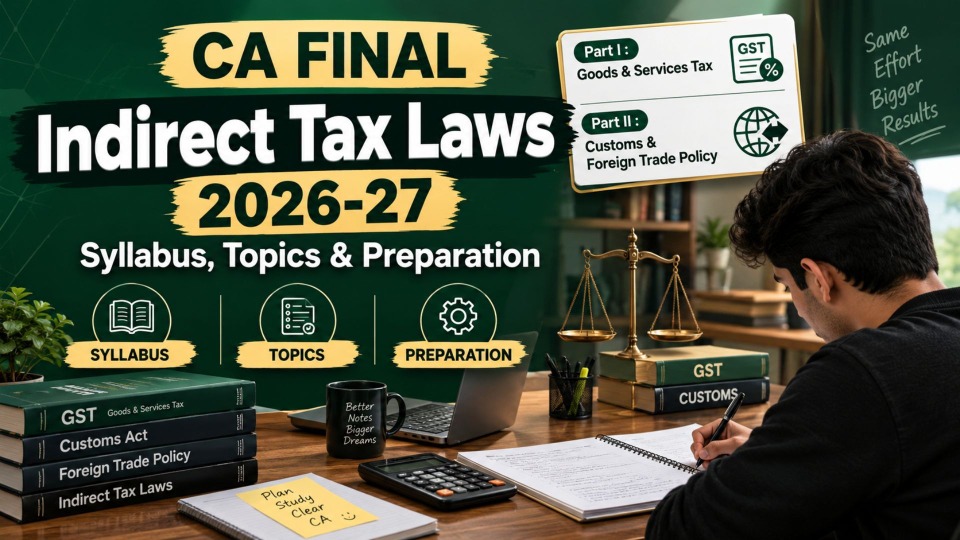
Paper 5 of the CA Final course, Indirect Tax Laws (IDT), is worth 100 points. The Goods and Services Tax (GST), Customs Law, and Foreign Trade Policy (FTP) are among the subjects covered in this article. It seeks to assess students' comprehension of tax laws and their capacity to use them in real-world contexts.
Students preparing for the CA Final IDT in 2026–2027 should concentrate on developing strong conceptual clarity in addition to practicing practical and case-based questions from the syllabus on a regular basis.
There are two sections to the CA Final IDT. Goods and Services Tax is covered in Part I (80 marks), and Customs and FTP are covered in Part II (20 marks).
| Indirect Tax Laws Marks Breakdown | ||
|---|---|---|
| Part | Subject | Marks |
| Part I | Goods and Services Tax (GST) | 80 |
| Part II | Customs & Foreign Trade Policy (FTP) | 20 |
| Total | Indirect Tax Laws | 100 |
GST is worth 80 points and makes up the majority of the CA Final Indirect Tax Laws curriculum. The CGST Act of 2017 and the IGST Act of 2017 are included in the curriculum.
This section carries 45%-65% weightage and includes several important areas of GST law.
This section carries 10%-30% weightage.
This section carries 0%-5% weightage.
This section carries 15%-30% weightage.
The Customs Act of 1962 and the Customs Tariff Act of 1975 serve as the foundation for the Customs curriculum.
The fundamental ideas of India's foreign trade framework are covered in the FTP section.
There are a number of topics on the CA Final Indirect Tax Laws syllabus that call for both conceptual understanding and question practice.
Use the following link to get the CA Final Indirect Tax Laws 2026–2027 PDF. When getting ready for the CA Final IDT, keep the PDF close at hand so you may review the topics, syllabus, and mark distribution.
Instead of attempting to start by trying to start by trying to memorize all the rules at once. For speedy rewriting, provide brief notes that address key procedures, conditions, exceptions, and important parts.
Case-based questions derived from real-world scenarios are also included in GST. Following the completion of each topic, practice on the pertinent questions. This will make it easier for you to comprehend how GST laws are actually applied.
There are numerous clauses, requirements, and exclusions related to indirect taxation. Throughout your preparation, go over things frequently so that you can easily remember them without having to review everything right before the test.
The syllabus indicates that changes in legislation and specific inclusions or exclusions may impact the syllabus through announcements, yearly Finance Acts and Study Guidelines. As a result, students should review the most recent ICAI content relevant to their exam attempt.
A simple study routine can be:
CA Vipul Dhall is a first-attempt Chartered Accountant and All India Rank 43 in CA Finals, B.Com graduate from Hindu College, University of Delhi, he brings valuable corporate experience from PwC and Bharti Airtel, blending practical industry insights with a strong passion for teaching. With 6+ years of teaching experience, his mission is to inspire students to believe that the CA dream is achievable with the right guidance and discipline.
 Launch your Graphy