
There are no items in your cart
Add More
Add More
| Item Details | Price | ||
|---|---|---|---|

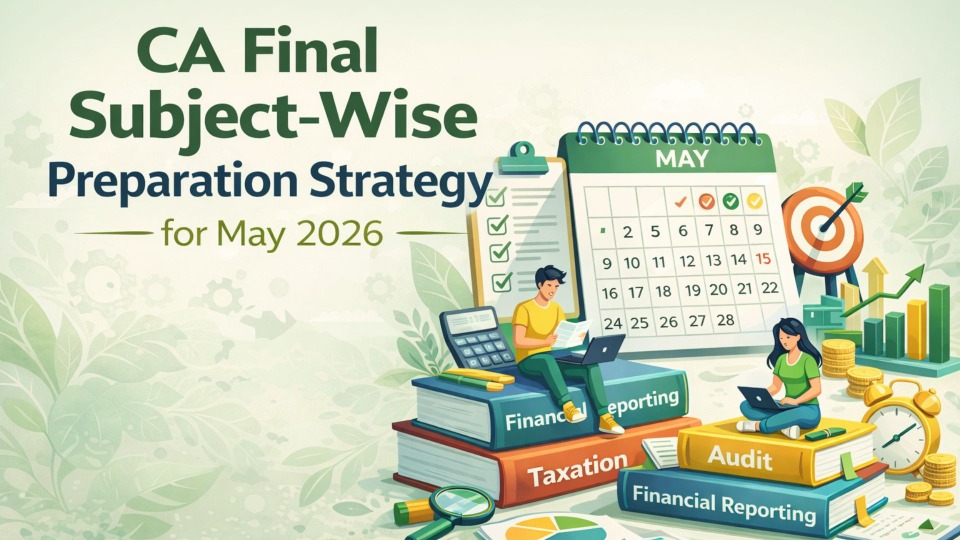
Your road toward becoming a chartered accountant culminates with passing the CA Final test, which is the result of years of perseverance, discipline, and hard work. It's critical to realize as you get ready for the May 2026 try that success requires not just a lot of effort but also a methodical and well-thought-out study strategy.
The best time to create a solid, subject-by-subject preparation strategy is during this phase. With the support of clever study strategies, efficient preparation tactics, and exam-focused insights, we present a methodical and realistic approach to CA Final May 2026 in this blog post, enabling you to confidently and clearly prepare.
Before focusing on individual subjects, it is essential to build a strong foundation for your preparation. A well-structured base will make your subject-wise strategy far more effective.
Understand the Syllabus Thoroughly:
Begin by carefully reviewing the latest ICAI CA Final syllabus under the New Scheme. Gain clarity on all subjects, detailed topics, weightage distribution, and the overall examination pattern. A clear understanding of what to study prevents unnecessary effort and ensures targeted preparation.
Define Clear Objectives:
Set specific and realistic goals for your May 2026 attempt. Whether you aim to secure an All India Rank, clear both groups in one go, or achieve exemptions in particular subjects, your preparation strategy should align with your ultimate objective.
Plan Your Time Strategically:
With adequate time available before May 2026, create a structured timeline. Divide your schedule into phases such as completion of classes (if applicable), first revision, second revision, and intensive mock test practice. Proper time allocation ensures balanced coverage of all subjects.
Choose and Manage Resources Wisely:
Rely primarily on ICAI study materials, including the Study Material, Practice Manuals, RTPs (Revision Test Papers), MTPs (Mock Test Papers), and relevant past examination papers under the new scheme. Additional reference books may be used selectively, but avoid overwhelming yourself with excessive resources.
Cultivate the Right Mindset:
Preparation for the CA Final is as much mental as it is academic. Maintain consistency, discipline, and a positive outlook throughout the journey. Challenges are inevitable, but resilience and focus will significantly influence your success.
Click on any batch to view details and enrol instantly!
Paper 1: Financial Reporting (FR)
Focus:
A strong conceptual command over Ind AS is essential. Understanding the interlinkages between various standards plays a crucial role in mastering this subject.
Strategy:
Begin your preparation early and focus on understanding the reasoning behind each accounting standard rather than rote learning. Give special attention to complex areas such as Business Combinations, Financial Instruments, and Consolidation. Consistent practice from ICAI Study Material and Practice Manuals is non-negotiable. Do not overlook theory-based questions related to accounting standards.
Best Approach: Solve practical questions manually to strengthen conceptual clarity. Prepare concise notes for each Ind AS, highlighting core principles, adjustments, and exceptions for quick revision.
Paper 2: Advanced Financial Management (AFM)
Focus:
A balanced combination of conceptual clarity and practical application is required. Strong analytical and problem-solving skills are key.
Strategy:
While memorizing formulas is important, understanding their derivation and practical relevance is equally critical. Cover high-weightage areas such as Portfolio Management, Derivatives, Forex Management, and Corporate Valuation in depth. Regular practice will improve speed and accuracy.
Best Approach:
Maintain a separate formula notebook for quick revision. Solve a wide variety of questions from ICAI resources and focus on understanding the assumptions behind financial models.
Focus:
In-depth understanding of Standards on Auditing (SAs), Professional Ethics, and specialized audit topics is required. This subject demands both conceptual clarity and effective presentation.
Strategy:
Divide the vast syllabus into manageable sections. Focus on understanding the intent and framework of SAs rather than memorizing blindly. Use ICAI keywords in your answers to improve scoring potential. Professional Ethics is often scoring and should be covered thoroughly. Try linking audit standards with practical scenarios.
Best Approach:
Create mnemonics to remember SA numbers and key provisions. Practice answer writing with proper structure and headings. Regular revision of ethical provisions is essential.
Paper 4: Direct Tax Laws & International Taxation
Focus:
Comprehensive understanding of Income Tax provisions along with International Taxation concepts is crucial. Staying updated with amendments is extremely important.
Strategy:
Start with basic provisions and gradually move to advanced topics such as Assessments, Appeals, PGBP, Capital Gains, and Transfer Pricing. Regularly update yourself with amendments relevant for the May 2026 attempt. International Taxation requires separate and focused preparation.
Best Approach:
Prepare summary notes for each chapter and important sections. Practice integrated problems that combine multiple provisions. Revise important sections, amendments, and case laws consistently.
Paper 5: Indirect Tax Laws (GST & Customs)
Focus:
Thorough conceptual clarity in GST (CGST & IGST) and Customs Law, with strong emphasis on practical application. Strategy:
Since GST is extensive, divide it into smaller modules such as Supply, ITC, Valuation, Returns, and Registration. Although Customs is comparatively smaller in volume, it carries equal importance. Prioritize conceptual understanding before moving to numerical problem-solving. Stay updated with relevant circulars and notifications.
Best Approach:
Use flowcharts to understand processes like registration and return filing. Practice a wide range of numerical questions. Maintain a separate notebook for amendments and important updates.
Paper 6: Integrated Business Solutions (Multi-Disciplinary Case Study)
Focus:
Application-based paper requiring integration of concepts from Accounts, Audit, Tax, Law, and Financial Management. Analytical and holistic thinking skills are essential.
Strategy:
Develop the habit of reading and analyzing case studies early in your preparation. Practice applying concepts from multiple subjects within a single scenario. Focus not only on technical aspects but also on ethical considerations and practical business solutions.
Best Approach:
Solve ICAI case studies extensively. Improve time management skills for reading and analyzing lengthy scenarios during the exam. Work on presenting structured, logical, and well-integrated answers.
6:00 AM – 7:00 AM: Wake up and get ready
7:00 AM – 9:30 AM: Study Session 1 (e.g., Theory – Audit/Law)
9:30 AM – 10:00 AM: Breakfast Break
10:00 AM – 1:00 PM: Study Session 2 (e.g., Practical – FR/AFM)
1:00 PM – 2:00 PM: Lunch Break
2:00 PM – 4:30 PM: Study Session 3 (e.g., Practical – DT/IDT)
4:30 PM – 5:00 PM: Short Break / Walk
5:00 PM – 7:00 PM: Study Session 4 (Revision or Question Practice)
7:00 PM onwards: Dinner, Relaxation, and preparation for the next day
Plan Multiple Revisions: Aim to complete at least 3–4 rounds of revision before the exam.
Prioritize Subjects Smartly: Distribute revision time based on the subject’s difficulty level and your level of comfort.
Practice-Based Revision: Avoid passive reading. Actively solve questions, attempt previous exam papers, and take topic-wise tests.
Mock Test Practice: Include full-syllabus mock tests in the final stages of revision to build exam temperament and time management skills.
With careful preparation, methodical execution, and steadfast commitment, it is possible to pass the CA Final in May 2026. Establish a strong subject-by-subject plan for the CA Final, use efficient study methods, effectively manage your time, and give revision top priority. Regardless of whether you choose to take CA final classes or just study on your own, diligence and consistency will be your biggest assets. Get started now, maintain your concentration, and enter the exam room with assurance! I wish you luck!
🚀 Ready to start your CA Journey?
Click the image or button above to explore our courses!
 Launch your Graphy