There are no items in your cart
Add More
Add More
| Item Details | Price | ||
|---|---|---|---|

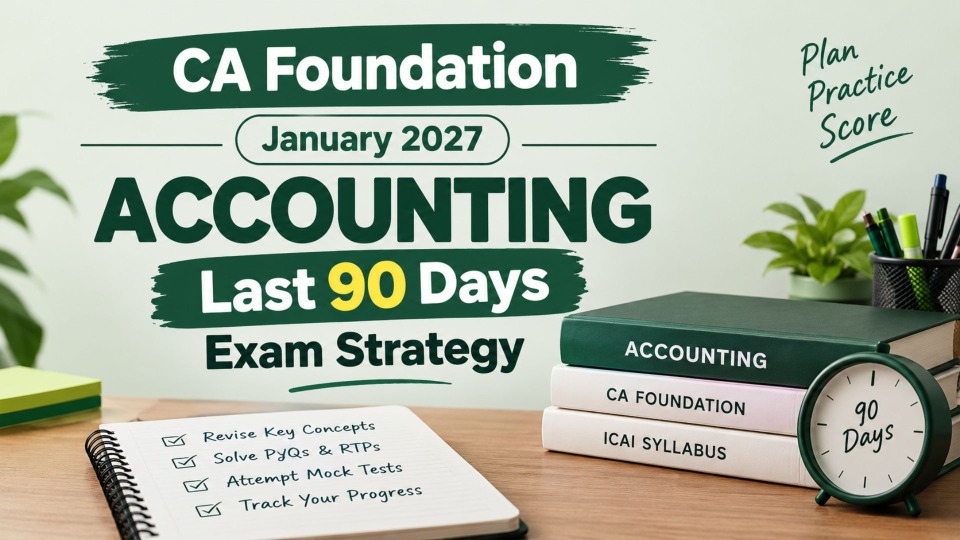
Topics related to accounting are interconnected. As you proceed from one chapter to the next, ideas that were previously discussed may reappear. Journal entries, for instance, are used when working with ledger accounts and final accounts and are a component of the accounting process. Because of this, accounting benefits greatly from ongoing learning and revision.
| CA Exam Preparation Strategy & Timeline | |
|---|---|
| Preparation Phase | Main Focus |
| Till 15 December 2026 | Complete the syllabus, revise completed chapters and practise questions |
| Final 15–16 days | Revise the complete syllabus, review marked questions and strengthen weak areas |
| Final 2–3 days | Attempt full-length mocks, analyse mistakes and improve speed and accuracy |
Revision should not be viewed as something that only starts after finishing the complete curriculum. You can improve concept retention and lessen the pressure of the last revision window by going over finished chapters again while working through fresh ones.
Aim to complete the entire Accounting syllabus by 15 December 2026. This is a suggested preparation target to ensure you have sufficient time for revision and practice, not an official ICAI deadline.While preparing, follow these steps:
Completing the syllabus on schedule is essential because the final days before the examination should be dedicated to revision, question practice and improving exam performance, rather than learning major portions of the syllabus for the first time.
If you are preparing through self-study, ensure that you cover the entire ICAI study material rather than depending solely on selected questions or short notes.
Your study resources should help you develop a clear understanding of accounting concepts and improve your ability to solve questions independently.Focus on the following:
Preparing your own notes can make the final revision more efficient, as you will be familiar with the way the concepts are explained and organised.Rather than writing lengthy explanations, create short and clear notes in your own words.Your revision notes should cover:
Don't put off reviewing all you've learned until December 15th.
Plan a little revision for a few days after finishing a chapter. Later, go over it once more as you prepare related chapters. Because accounting concepts and treatments may be found throughout the syllabus, this method works especially well in accounting.
A basic cycle of revision could be:
Learn → Practice → Revise → Test → Fix Errors
This enables you to pinpoint areas of weakness while there is still time to address them.
During the final revision, avoid spending time repeatedly solving every question from each chapter. Instead, focus on the questions that need additional attention.As you study each chapter, identify and mark questions that:
Previous Year Questions (PYQs) and Revision Test Papers (RTPs) should be an essential part of your examination preparation.
As part of this strategy, practise PYQs and RTPs from the previous 12 examination attempts, giving special attention to the most recent three attempts. This is a suggested preparation approach and not an official ICAI requirement.Follow a chapter-wise method to make your practice more effective:
Practising questions from several examination attempts provides broader exposure, but the latest three attempts should receive extra attention during the final phase of your preparation.Use these papers to:
Taking weekly tests allows you to evaluate your preparation regularly and identify mistakes while you still have sufficient time to work on them.Consider each test an opportunity for self-assessment rather than a way to compare your performance with others.After completing every test, review the following:
Use the final 15–16 days for concentrated review and practice after finishing the course by December 15, 2026.
This time should not be viewed as another comprehensive first reading of the syllabus. As the test draws near, you should revise more quickly and selectively.
During the final revision phase, give priority to the following activities:
throughout the last 15 to 16 days, the question index you generate throughout preparation can be quite helpful.
Sort the questions by chapter and mark them in accordance with your level of preparedness.
For Example:
| Question Marking & Revision Strategy | |
|---|---|
| Category | What to Mark |
| High priority | Questions you repeatedly get wrong |
| Revision | Questions involving important concepts or adjustments |
| Practice | Questions requiring more writing practice |
| Quick review | Questions you can solve confidently but want to revisit |
The final 2–3 days before the examination should be dedicated to improving exam readiness rather than covering substantial new topics.
If your preparation is on track, aim to attempt 2–3 full-length mock tests under timed conditions during this period. This is a suggested preparation strategy, not an official ICAI examination requirement.After completing each mock test, focus on the following:
For further guidance on revision planning and mock-test practice, refer to the CA Foundation Accounting Revision Strategy: Last 30 Days Plan
.A practical preparation approach for CA Foundation January 2027 Accounting is to complete the syllabus by 15 December 2026 and utilise the remaining 15–16 days for targeted revision and question practice. Consistent revision, complete coverage of the study material, personal notes, PYQs, RTPs and weekly tests can help you build a stronger preparation base throughout the final 90 days.
During the last few days, concentrate on marked questions, frequently repeated mistakes and timed mock tests. This focused approach can help you make better use of your remaining preparation time and enter the examination with improved accuracy, confidence and time-management skills.
CA Vipul Dhall is a first-attempt Chartered Accountant and All India Rank 43 in CA Finals, B.Com graduate from Hindu College, University of Delhi, he brings valuable corporate experience from PwC and Bharti Airtel, blending practical industry insights with a strong passion for teaching. With 6+ years of teaching experience, his mission is to inspire students to believe that the CA dream is achievable with the right guidance and discipline.
 Launch your Graphy