There are no items in your cart
Add More
Add More
| Item Details | Price | ||
|---|---|---|---|

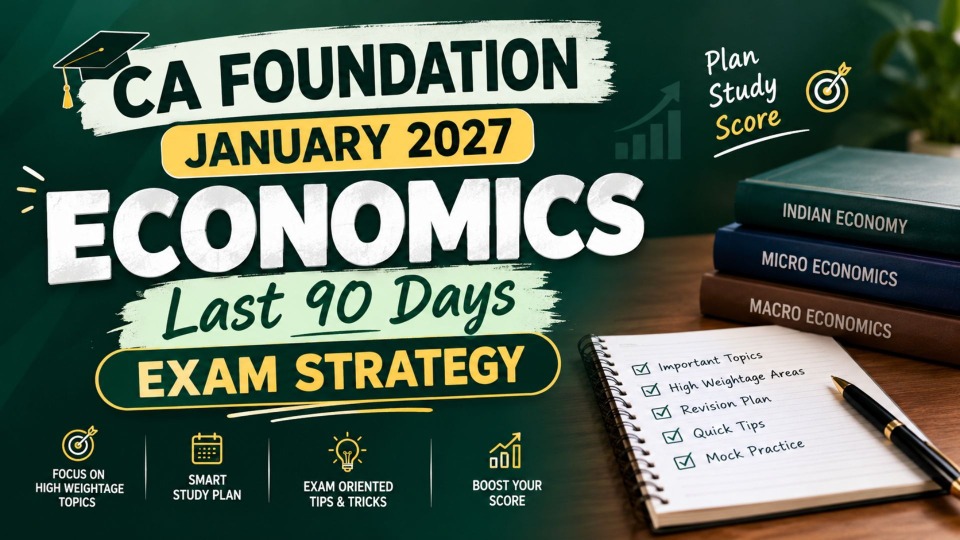
When syllabus completion, review, and question practice begin to compete for the same study time, it can become challenging to prepare for CA Foundation Economics in the final ninety days. If you devote all of your time to finishing chapters, you might not have enough time to properly edit them or practice questions prior to the test.
Combining learning and revision from the start of the ninety days is a better strategy. A useful method for handling the final 90 days is provided in the CA Foundation Jan 2027 Economics Last 90 Days Strategy video by PW, which covers question practice, syllabus completion, and review. Exam-focused learning materials, courses, and revision are further ways that PW CA Foundation batches can help you get ready.
You should split up the ninety days based on how prepared you are right now. While students who are starting from scratch might require a quicker syllabus completion timeline, those who have already covered a significant portion of the curriculum might dedicate more time to practice and review.
| Preparation Stages & Focus Strategy | |
|---|---|
| Preparation Stage | Main Focus |
| Syllabus completion | Complete pending chapters and set daily study targets |
| Revision | Revisit completed chapters through notes and one-shot revision |
| Practice | Solve previous-attempt questions, assignments and mock tests |
Completing the syllabus provides the basic foundation for your examination preparation, but it should not be considered the final objective. You also need to retain important concepts, apply them while solving questions, and become familiar with the different types of questions that may appear in the exam.
Your preparation should therefore include:
1. Syllabus Completion
Make a list of all the chapters that are still incomplete and distribute them across the days available for preparation. Set daily or weekly goals that are practical and achievable.
2. Revision
Revise each chapter shortly after completing it. Regular revision helps strengthen retention and reduces the need to relearn concepts from the beginning later.
3. Practice
Start solving questions once you have studied a topic. Gradually include previous-attempt questions, assignments, and mock tests as your preparation advances.A simple preparation cycle you can follow is:
Complete the Chapter → Revise → Practise → Revisit
If you have already begun preparing for CA Foundation Economics, avoid using the entire remaining preparation period only to finish the chapters that are still pending.
You can set a target of completing the syllabus by 10 December and then use the remaining time more effectively for revision and practice. This is a suggested preparation target and not an official ICAI deadline.
Once the syllabus is completed, focus on:
One effective way to prevent a heavy revision backlog is to revise each chapter soon after completing it.
You can follow this cycle for every chapter:
Complete Chapter → One-Shot Revision → Revise Notes → Practise Questions → Repeat
For instance, once you finish a chapter, quickly revise it using your notes, solve the related questions, and identify the concepts where you make mistakes. During your next revision, you can give extra attention to those areas instead of revisiting the entire chapter from scratch.
This method also makes the final revision phase more manageable, as you have already reviewed the chapters several times throughout your preparation.
Your notes can be a valuable resource during the final 90 days of preparation. Rather than repeatedly watching lengthy classes for concepts you have already understood, use concise notes to revise important concepts, definitions, and key points efficiently.
During your preparation, you can:
Question-solving should gradually increase as you approach the CA Foundation January 2027 examination.
Previous-Attempt Questions: Solve questions from previous attempts after revising the relevant topic. This can help you understand how concepts are examined and highlight areas where additional preparation may be required.
Mock Tests: Add mock tests to the later stages of your preparation. They can help you evaluate your exam readiness and improve your ability to manage time while attempting the paper.
Assignments: Use assignments for additional practice after completing individual chapters. They can help you assess whether you are able to apply the concepts independently without constantly referring to your notes.
Practice Questions: Do not postpone question practice until the final weeks. Solving questions along with syllabus completion allows you to identify and address preparation gaps at an earlier stage.
When preparing for CA Foundation Economics in 2027, you need pay constant attention to economics. Make it a regular part of your weekly routine to review and practice economics instead of merely studying it after finishing the other subjects.
If your level of preparation permits, aiming for a 90+ score in Economics can be a helpful goal. This is not an official ICAI guideline or a mark guaranty; rather, it is a personal preparation goal.
To improve your CA Foundation Economics preparation, follow a structured approach:
Revision can get more challenging if you follow multiple professors for the same subject. Different teaching methods, vocabulary, and styles might lead to disorganized notes and repetitive learning.
In general, it is preferable to stick to a single, reliable method of teaching economics throughout your training. When you require clarification on a certain idea, you can use another resource, but don't keep jumping between full courses.
Students must use the 90 days available if they are beginning their CA Foundation Business Economics preparation from scratch.
You can complete the syllabus in less time by using a fast-track batch or recorded and live classes. But finishing classes shouldn't be the main objective.
Follow a preparation cycle that balances learning, revision, and regular practice:
Different kinds of preparation are needed for the four CA Foundation papers. Therefore, instead of following the same approach for every paper, your study strategy should incorporate subject-specific practice.
| Subject-Wise Preparation Focus | |
|---|---|
| Subject | Preparation Focus |
| Law | Answer-writing practice |
| Accounts | Numerical and problem-solving practice |
| Economics | Concept revision and question practice |
| Other subjects | Syllabus completion, revision, notes and practice |
Your total CA Foundation study plan must include economics preparation. If one paper is given too much time, other subjects may not have enough time for review.
A study day can be broken up into many blocks, like:
30 Days Before the Exam Finish any remaining portions of the syllabus and start revising more frequently. Increase your focus on practising previous-attempt questions and completing assignments.
15 Days Before the Exam Give greater priority to your notes, key concepts, previous-attempt questions, mock tests, and topics where you have made repeated mistakes.
Final Days: Use concise notes and revision resources to quickly review the syllabus. Avoid attempting to study every chapter from the beginning again. Focus on recalling concepts, practising questions, and revisiting areas that still need improvement.
The last 90 days of preparation become more manageable when you regularly monitor your progress instead of studying without clear goals.
1. Monitor Your Pending Syllabus
Keep a record of all unfinished chapters and update the list as you complete each one.
2. Continue Revising Completed Chapters
Do not postpone revision until the entire syllabus has been completed. Keep revisiting finished chapters throughout your preparation.
3. Stay Consistent
Follow one main learning approach for Economics rather than frequently switching between different instructors or complete courses.
4. Practise After Completing Topics
Solve relevant questions soon after finishing a chapter. This helps you identify gaps in your understanding at an early stage.
5. Review Your Mistakes
Analyse incorrect answers from assignments, previous-attempt questions, and mock tests to identify topics where you repeatedly face difficulties.
6. Gradually Increase Exam Practice
As the examination draws closer, dedicate more time to mock tests, previous-attempt questions, and repeated revision.
1. How should I prepare for CA Foundation Economics January 2027?
Start by completing the syllabus systematically and revise each chapter soon after studying it. Use concise notes for revision, practise previous-attempt questions and assignments, and gradually include mock tests. Keep analysing your mistakes and revisit weak areas regularly.
2. What is the CA Foundation Economics last 90 days strategy?
Use the final 90 days to balance syllabus completion, revision, and question practice. Complete the pending syllabus first, revise completed chapters alongside your ongoing studies, practise questions regularly, and increase mock-test and exam-oriented practice as the examination approaches.
3. When should I complete the CA Foundation syllabus?
You can aim to complete the CA Foundation Economics syllabus by around 10 December and use the remaining preparation period for revision, question practice, and mock tests. This is a suggested preparation target and not an official ICAI deadline.
4. Is 90+ a good target for CA Foundation Economics?
Yes, aiming for 90+ can be a strong preparation target if you have sufficient time and can maintain consistent practice. However, your primary focus should be on complete syllabus coverage, conceptual clarity, regular revision, and accurate question-solving rather than focusing only on a particular score.
CA Vipul Dhall is a first-attempt Chartered Accountant and All India Rank 43 in CA Finals, B.Com graduate from Hindu College, University of Delhi, he brings valuable corporate experience from PwC and Bharti Airtel, blending practical industry insights with a strong passion for teaching. With 6+ years of teaching experience, his mission is to inspire students to believe that the CA dream is achievable with the right guidance and discipline.
 Launch your Graphy