There are no items in your cart
Add More
Add More
| Item Details | Price | ||
|---|---|---|---|

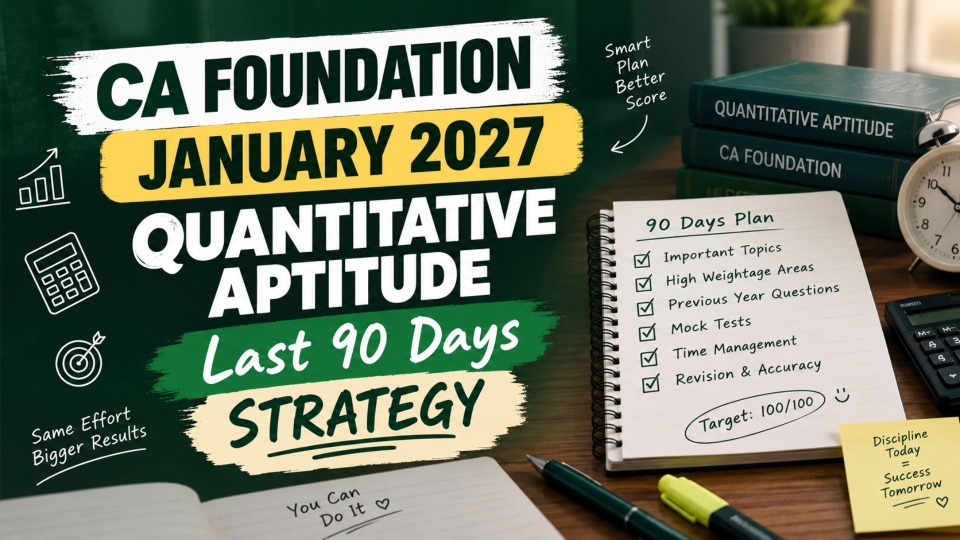
With the CA Foundation January 2027 examination drawing closer, candidates should make the most of the final 90 days by focusing on revision, consistent question-solving, and mock test practice. Instead of leaving the entire syllabus for the last few weeks, students should aim to complete the remaining topics, revise key concepts, and work on areas that require additional attention. The September 2026 Quantitative Aptitude paper also highlights the need to develop speed and accuracy through regular practice.
Before preparing a study schedule, review the CA Foundation Quantitative Aptitude syllabus 2026-27 and categorise the chapters into completed topics, areas needing more practice, and concepts that require further revision. Students can also refer to PW's Quantitative Aptitude notes, formula revision sessions, and practice materials to support their preparation as they progress from syllabus completion to revision and mock tests.
To avoid significant overlap between final revision and syllabus completion, a three-month preparation period can be broken up into distinct phases.
| Study & Preparation Strategy | |
|---|---|
| Preparation Phase | Main Focus |
| Till 30 November 2026 | Complete the syllabus, understand concepts and practise questions[cite: 15] |
| December 2026 | Revise formulas, practise questions, attempt mock tests and correct mistakes[cite: 15] |
| Final days before the exam | Quick revision, weak-area practice and exam-oriented preparation[cite: 15] |
Your total CA Foundation schedule will determine how many hours you spend studying each day.
Establish November 30, 2026, as the deadline for finishing the Quantitative Aptitude curriculum. This is not an official ICAI deadline; rather, it is a goal for study preparation.
Don't wait until the last few weeks to finish several important chapters. If a subject is challenging for you, take more time to grasp its ideas before practicing the questions.
After completing the syllabus, dedicate December to revising previously covered topics and improving your overall preparation. Beginning major chapters from the start during this period may reduce the time available for question-solving and mock test practice.
well-planned December study routine can include:
Once you have finished most or all of the material, mock examinations become more beneficial. Prior to the exam in January 2027, try to complete at least five practice exams.
The exams can be distributed throughout December, and you can use your results to determine which areas require additional focus. The five-test aim is not an official ICAI requirement; rather, it is a guideline for preparation.
After completing a mock test, do not focus only on the marks obtained. Take time to review your performance and identify:
Don't leave chapters unfinished. There are gaps in your total preparation if you simply prepare for the subjects you are familiar with. This is because Quantitative Aptitude covers a variety of problems in Business Mathematics, Logical Reasoning, and Statistics.
Before choosing to skip a chapter, consider the following factors:
It is not advisable to leave probability unprepared. Instead than depending just on formula memorization, go over its fundamental ideas and practice questions.
Add those questions to your revision notes and go over them again in December if you have consistently made mistakes in probability.
Numerical questions shouldn't be the only way to prepare for quantitative aptitude. Theoretical sections should also receive enough attention.
Update your syllabus's definitions, concepts, and other theory-based sections. This can assist you in keeping your preparation for the paper balanced.
Prioritizing topics based on your level of preparation may be necessary if you have limited time. Depending on how much time you have and how well you grasp the subject, calculus might be prioritized differently.
This should not, however, be interpreted as a formal ICAI exemption or as a sign that Calculus won't be covered in the test.
Detailed one-shot sessions can be useful for students who have already covered a chapter but need to strengthen their conceptual understanding.
Rather than watching the session passively, combine it with active question practice by following this approach:
Concept → Formula/Method → Solved Example → Independent Practice → Mistake Analysis
If you repeatedly make errors in a particular concept, go back to that section, revise it carefully, and then attempt related questions again before moving on to advanced-level problems.
One-shot sessions can be especially helpful during the final months of preparation, as they allow students to revisit challenging topics efficiently without having to study the entire syllabus from the beginning.
When you have to precisely answer questions in a short period of time, formula retention becomes quite helpful.
outset making frequent formula revisions from the outset of your last 90-day preparation, rather than waiting until December.
Every day, dedicate a brief period of time to reviewing formulas from the chapters you have finished.
Review the formulas that were discussed in the preceding days once a week. This might assist you in determining which formulas require more regular adjustment.
It is insufficient to know a formula. To learn when and how to use it, practice answering various kinds of questions.
Maintain a brief, handwritten formula journal. Include quick reminders to help you avoid repeating mistakes along with formulas you often forget.
Your previous mistakes can become a valuable part of your final preparation if you review and learn from them properly.
After completing a mock test, chapter-wise test, or practice session, keep a record of the mistakes you make repeatedly.
You can organise these errors into different categories:
For candidates preparing for another attempt, it can also be helpful to review the approach followed during the previous preparation. Compare it with your current study plan and identify the areas where changes or improvements are required.
| Preparation Guidelines & Action Plan | |
|---|---|
| Preparation Area | Recommended Action |
| Syllabus completion | Target completion by 30 November 2026 |
| December preparation | Focus mainly on revision and practice |
| Mock tests | Aim to attempt at least five papers |
| Chapter coverage | Avoid skipping chapters unnecessarily |
| Probability | Revise concepts and practise questions |
| Theoretical topics | Include them in your preparation |
| Formula retention | Maintain handwritten notes and revise regularly |
| Concept clarity | Use detailed one-shot sessions for difficult areas |
| Question practice | Use the Sankat Mochan series for revision and practice |
| Mistake correction | Analyse errors and revisit weak areas |
Take some time to identify any holes in your prior preparation if you are getting ready for another try. Establish a schedule that allows you adequate time for both syllabus review and coverage if this is your first appearance.
As December moves forward, your preparation should gradually shift from learning new topics to improving exam performance and revision.Use the following checklist to stay on track:
1. When should you complete the CA Foundation Quantitative Aptitude syllabus for the January 2027 attempt?
Ideally, candidates should aim to complete the CA Foundation Quantitative Aptitude syllabus by the end of November 2026. This leaves December for revision, question practice, mock tests, and improving weak areas before the January 2027 examination.
2. How many mock tests should you attempt for CA Foundation Quantitative Aptitude?
Candidates should aim to attempt at least five full-length mock tests before the examination. More importantly, each mock test should be properly analysed to identify conceptual mistakes, calculation errors, time-management issues, and topics that require further revision.
3. Should you skip Probability for CA Foundation Quantitative Aptitude?
Candidates should avoid skipping Probability without first assessing their preparation. If the topic is difficult, focus on understanding its basic concepts and practising important question types rather than completely leaving it out. A balanced approach can help reduce the risk of missing questions from the topic.
4. Should you study theoretical topics in Quantitative Aptitude?
Yes. Candidates should not focus only on numerical questions. Understanding the theoretical concepts, definitions, formulas, and methods is important because it supports accurate problem-solving and helps in answering concept-based questions effectively.
CA Vipul Dhall is a first-attempt Chartered Accountant and All India Rank 43 in CA Finals, B.Com graduate from Hindu College, University of Delhi, he brings valuable corporate experience from PwC and Bharti Airtel, blending practical industry insights with a strong passion for teaching. With 6+ years of teaching experience, his mission is to inspire students to believe that the CA dream is achievable with the right guidance and discipline.
 Launch your Graphy