
CA Foundation curriculum 2026: The Institute of Chartered Accountants of India (ICAI) establishes the ICAI CA Foundation curriculum, which includes important topics including corporate law, taxation, and auditing. Candidates must pass all four CA Foundation course papers in order to advance to the CA Intermediate level.
Although the CA test is rigorous at every level, the Foundation syllabus is usually thought to be the simplest, while the CA Final syllabus is the hardest. Each of the four papers in the CA Foundation course covers a variety of subjects.
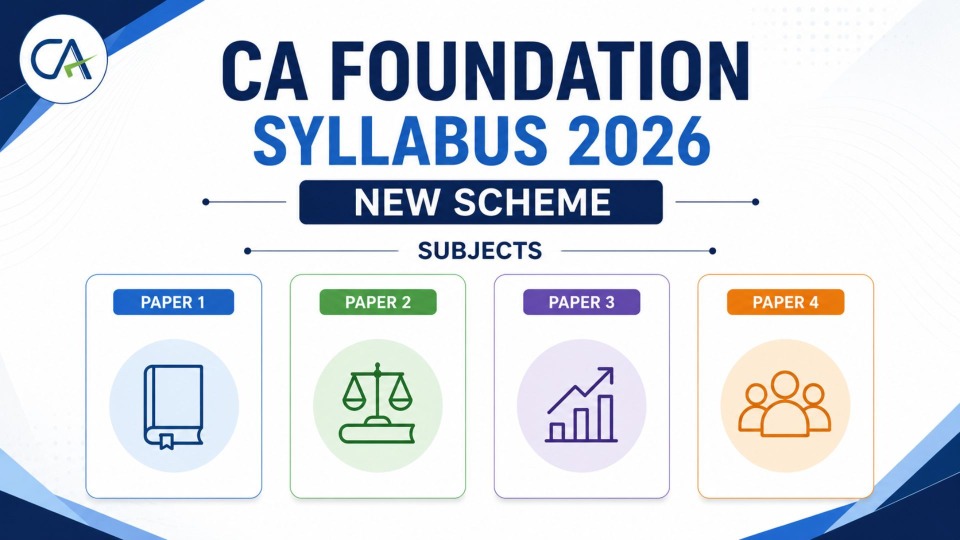
Four core papers make up the CA Foundation Syllabus 2026, which aims to provide students with a solid foundation in accounting and business concepts. Among them are: Accounting Paper 1 and Business Laws Paper 2 Paper 3: Quantitative Proficiency Paper 4: Economics of Business Each paper emphasizes analytical abilities and conceptual clarity while fusing theoretical knowledge with real-world applications. Students receive a strong foundation through ICAI's organized curriculum, which prepares them for their CA path.
The CA Foundation curriculum 2026 is summarized for candidates in the table below. In order to prepare for the CA Foundation May 2026 exam, students must concentrate on four papers according to the present CA Foundation exam schedule. The value of each paper will be 100 points. For more details, see the table below.
| Particulars | Details |
|---|---|
| Examination name | CA Foundation exam, earlier known as CA CPT (Common Proficiency Test) |
| Exam conducting body | The Institute Of Chartered Accountants of India (ICAI) |
| Exam mode | Pen-paper-based or offline |
| Exam level | National Level |
| Exam difficulty | Easy to moderate |
| Number of paper | 4 |
| Paper names |
Paper 1 - Principles and Practice of Accounting Paper 2 - Business Laws and Business Correspondence and Reporting Paper 3 - Business Mathematics, Logical Reasoning and Statistics Paper 4 - Business Economics and Business and Commercial Knowledge |
| Exam duration |
3 hours for Paper 1 and Paper 2 2 hours for Paper 3 and Paper 4 |
| Maximum marks for each paper | 100 |
| Total marks for all 4 papers | 400 |
| Marking scheme | There will be no negative marking in Papers 1 and 2 as questions will be descriptive. However, ¼ mark will be deducted for every wrong answer in Paper 3 and Paper 4 as questions will be multiple-choice. |
| Medium of exam | English/Hindi except section B for Paper 2 |
Click on any batch to view details and enrol instantly!
| Sl. No | Paper Name | Marks | Type of Questions |
|---|---|---|---|
| Paper 1 | Accounting | 100 Marks | Objective |
| Paper 2 | Business Laws | 100 Marks | Objective |
| Paper 3 |
Quantitative Aptitude-Part A: Business Mathematics Part B: Logical Reasoning Part C: Statistics |
100 Marks Part A: 40 Marks Part B: 20 Marks Part C: 40 Marks |
Subjective |
| Paper 4 | Business Economics | 100 Marks | Subjective |
The goal of Paper 1 is to help you understand basic accounting concepts and principles so that you may properly construct financial statements and solve simple accounting difficulties. An outline of the CA Foundation syllabus (new scheme) for Paper 1 is provided below:
| Chapters | Units |
|---|---|
| Module 1 | |
| Chapter 1: Theoretical Framework |
|
| Chapter 2: Accounting Process |
|
| Chapter 3: Bank Reconciliation and Statement | - |
| Chapter 4: Inventories | - |
| Chapter 5: Depreciation and Amortisation | - |
| Chapter 6: Bills of Exchange and Promissory Notes | - |
| Chapter 7: Preparation of Final Accounts of Sole Proprietors |
|
| Module 2 | |
| Chapter 8: Financial Statements of Not-for-Profit Organisations | - |
| Chapter 9: Accounts from Incomplete Records | - |
| Chapter 10: Partnership and LLP Accounts |
|
| Chapter 11: Company Accounts |
|
The CA Foundation test 2026's second paper is devoted to business laws. Here, the primary objective is to assist students in understanding key components of particular business regulations and equipping them to deal with real-world problems associated with these laws.
| Chapter | Units |
|---|---|
| Chapter 1: Indian Regulatory Framework | - |
| Chapter 2: The Indian Contract Act, 1872 |
|
| Chapter 3: The Sale of Goods Act, 1930 |
|
| Chapter 4: The Indian Partnership Act, 1932 |
|
| Chapter 5: The Limited Liability Partnership Act, 2008 | - |
| Chapter 6: The Companies Act, 2013 | - |
| Chapter 7: The Negotiable Instruments Act, 1881 | - |
The purpose of this section is to help you understand basic statistical and mathematical ideas and how they apply to business, finance, and economics. It also emphasizes improving your capacity for logical reasoning and applying it to solve simple challenges. An outline of the CA Foundation syllabus (new scheme) for Paper 3 is provided below:
| CA Foundation Syllabus 2026 for Quantitative Aptitude | |
|---|---|
| Part A- Business Mathematics | |
| Chapter 1: Ratio and Proportion, Indices, Logarithms | Chapter 5: Basic Concepts of Permutations and Combinations |
| Chapter 2: Equations | Chapter 6: Sequence and Series – Arithmetic and Geometric Progressions |
| Chapter 3: Linear Inequalities | Chapter 7: Sets, Relations and Functions, Basics of Limits and Continuity functions |
| Chapter 4: Mathematics of Finance | Chapter 8: Basic Applications of Differential and Integral Calculus in Business and Economics (A) Differential Calculus (B) Integral Calculus |
| PART-B: Logical Reasoning | |
| Chapter 9: Number Series, Coding and Decoding and Odd Man Out | Chapter 11: Seating Arrangements |
| Chapter 10: Direction Tests | Chapter 12: Blood Relations |
| PART-C: Statistics | |
| Chapter 13: Unit I: Statistical Representation of Data Unit II: Sampling | Chapter 14: Measures of Central Tendency and Dispersion Unit I: Measures of Central Tendency Unit II: Dispersion |
| Chapter 15: Probability | Chapter 16: Theoretical Distributions |
| Chapter 17: Correlation and Regression | Chapter 18: Index Numbers |
We explore business economics in Paper 4 of the CA Foundation exam. This article's primary goal is to help you understand the fundamental ideas and theories of business economics and discover how to apply them to real-world issues.
| Chapter | Units |
|---|---|
| Chapter 1: Nature & Scope of Business Economics |
|
| Chapter 2: Theory of Demand and Supply |
|
| Chapter 3: Theory of Production and Cost |
|
| Chapter 4: Price Determination in Different Markets |
|
| Chapter 5: Business Cycles | - |
| Chapter 6: Determination of National Income |
|
| Chapter 7: Public Finance |
|
| Chapter 8: Money Market |
|
| Chapter 9: International Trade |
|
| Chapter 10: Indian Economy | - |
Here are some pointers for getting ready for the 2026 CA Foundation Syllabus:
CA Vipul Dhall is a first-attempt Chartered Accountant and All India Rank 43 in CA Finals, B.Com graduate from Hindu College, University of Delhi, he brings valuable corporate experience from PwC and Bharti Airtel, blending practical industry insights with a strong passion for teaching. With 6+ years of teaching experience, his mission is to inspire students to believe that the CA dream is achievable with the right guidance and discipline.
 Launch your Graphy