There are no items in your cart
Add More
Add More
| Item Details | Price | ||
|---|---|---|---|

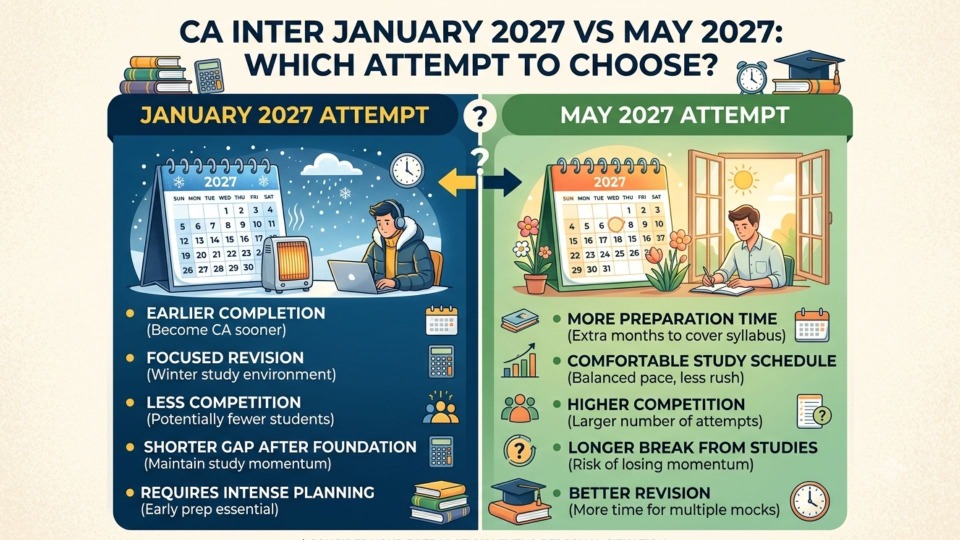
You must take into account your completion of the CA Intermediate January 2027 vs. May 2027 syllabus, group preparation, and the amount of time you have for practice and review. If you have previously done a lot of preparation under the previous Income Tax Act, the choice is very crucial. The Income Tax Act of 1961 will be the final try in January 2027, and the Income Tax Act of 2025 will be used in May 2027.
Determine which group you can fully prepare for by honestly evaluating your preparation before selecting an attempt.
When choosing between the two options, the transition between the old and new Income Tax Acts is a key consideration. The Income Tax Act of 1961 will expire in January 2027, and the Income Tax Act of 2025 will take effect in May 2027.
Delaying the attempt could require you to prepare under a new tax framework for the subsequent try if you have already spent a lot of effort preparing Direct Tax under the current framework. Your present Direct Tax preparation is therefore a crucial component of the choice.
The January 2027 attempt may be a suitable option if you have made substantial progress with your preparation and feel confident about completing the revision and practice for your chosen group. If your preparation is already well advanced, especially for Group 1, targeting the January 2027 examination could help you build on the work you have completed so far.Before deciding to appear in January, evaluate the following factors:
If you need more time to complete the necessary parts of your January preparation, you might take May 2027 into consideration. You can think about concentrating on Group 2 in January 2027 and using the extra time to study the new Income Tax Act for Group 1 in May 2027 if you are not ready for Group 1.
Instead of attempting to finish a poorly planned Group 1 under the previous tax structure, this method enables you to keep preparing. Your final choice, however, should be based on your level of preparation, group development, and your capacity to effectively revise the chosen subjects.
The January 2027 attempt may be a suitable option if you have made substantial progress with your preparation and feel confident about completing the revision and practice for your chosen group. If your preparation is already well advanced, especially for Group 1, targeting the January 2027 examination could help you build on the work you have completed so far.
Before deciding to appear in January, evaluate the following factors:
Trying to get everything ready for January might not be the best course of action if your preparation is lacking. You can think about developing the new Income Tax Act for Group 1 in May 2027 and concentrating on Group 2 in January 2027.
In situations when Group 1 is not adequately equipped for January but Group 2 can be realistically prepared for the attempt, this strategy may be taken into consideration. The new tax structure that applies to Group 1 in May can then take advantage of the extra time for preparation.
The January versus May decision should heavily rely on your current Direct Tax preparation. Determine whether your current preparation may be transformed into a successful January try if you have already studied the previous Income Tax Act in great detail.
Efficiency in preparation is the most important factor. If you have extensive preparation under the previous law, first determine how much of that preparation can be improved and revised for January, as delaying the attempt may require preparation under the new tax framework.
This does not imply that January is always the best option. The choice should still be based on your overall completion of the syllabus, group preparation, strengths, and capacity for revision within the remaining period.
If you can prepare at least one group thoroughly, appearing for that group in January 2027 may allow you to gain valuable exam experience while building on the preparation you have already completed.Some potential advantages include:
The decision between the January and May attempts should not depend solely on which attempt other students are targeting. Instead, your current preparation level, subject knowledge, and ability to revise effectively should guide your decision.Before finalising your attempt, consider the following factors:
Your decision between the January 2027 and May 2027 efforts should be based on your level of preparation, group readiness, and current Direct Tax preparation. The strategy for various preparation scenarios is summarized in the table below.
| Strategic Preparation & Decision Matrix | |
|---|---|
| Your Situation | Recommended Approach |
| Well-prepared and confident | Focus on clearing Group 1 in January 2027 |
| Preparation incomplete | Consider focusing on Group 2 in January and preparing the new Income Tax Act content for Group 1 in May |
| Already studied the old Income Tax Act extensively | Maximise preparation for the January attempt |
| Not fully prepared for both groups | Consider attempting at least one group rather than skipping completely |
| Following others' decisions | Reassess based on your own preparation and strengths |
Once you have finalised your examination attempt and selected a group, stay committed to that decision and organise your preparation accordingly. Focus on giving your best effort to the chosen group instead of appearing for the examination with incomplete preparation.
Keep these priorities in mind:
The last three months before the CA Intermediate examination should be dedicated to finishing the pending syllabus for your selected group, revising key concepts, and practising questions consistently. Rather than attempting to study everything at once, use this time to improve your understanding, strengthen exam readiness, and identify topics that require additional attention.
Is January 2027 or May 2027 better for CA Intermediate?
The choice between the January 2027 and May 2027 CA Intermediate attempts depends on your syllabus completion, revision progress, and readiness for the examination. If you have completed most of your syllabus and can dedicate sufficient time to revision and question practice, you may consider January 2027. If you need more time to cover the syllabus and strengthen your concepts, May 2027 may give you additional preparation time.Before deciding, review your group-wise preparation, the time available for revision, and the applicable syllabus and tax-law provisions for your attempt.
Should I attempt CA Intermediate in January 2027 if my preparation is incomplete?
You should first assess how much of your selected group's syllabus remains incomplete and whether you can realistically cover the important topics, revise them, and practise questions before the examination. If only a few topics are pending and your fundamentals are strong, January 2027 may still be an option. However, if substantial portions remain uncovered, consider whether the additional preparation time before May 2027 would be more beneficial.Avoid choosing an attempt simply because other students are appearing for it. Make your decision based on your preparation level and your ability to complete a realistic study plan.
Why is Direct Tax important when choosing between January and May 2027?
Direct Tax preparation is an important consideration because the applicable Income-tax law, syllabus, and transition arrangements may affect how your existing preparation can be used for a particular examination attempt. If you have already studied extensively under an earlier tax-law framework, check whether that preparation remains relevant for your selected attempt.Before finalising your plan, verify the applicable Direct Tax syllabus, relevant amendments, and transition rules through the latest official ICAI announcements. This will help you decide how to allocate your remaining study time and whether your existing preparation aligns with the requirements of the January or May 2027 examination.
CA Vipul Dhall is a first-attempt Chartered Accountant and All India Rank 43 in CA Finals, B.Com graduate from Hindu College, University of Delhi, he brings valuable corporate experience from PwC and Bharti Airtel, blending practical industry insights with a strong passion for teaching. With 6+ years of teaching experience, his mission is to inspire students to believe that the CA dream is achievable with the right guidance and discipline.
 Launch your Graphy