There are no items in your cart
Add More
Add More
| Item Details | Price | ||
|---|---|---|---|

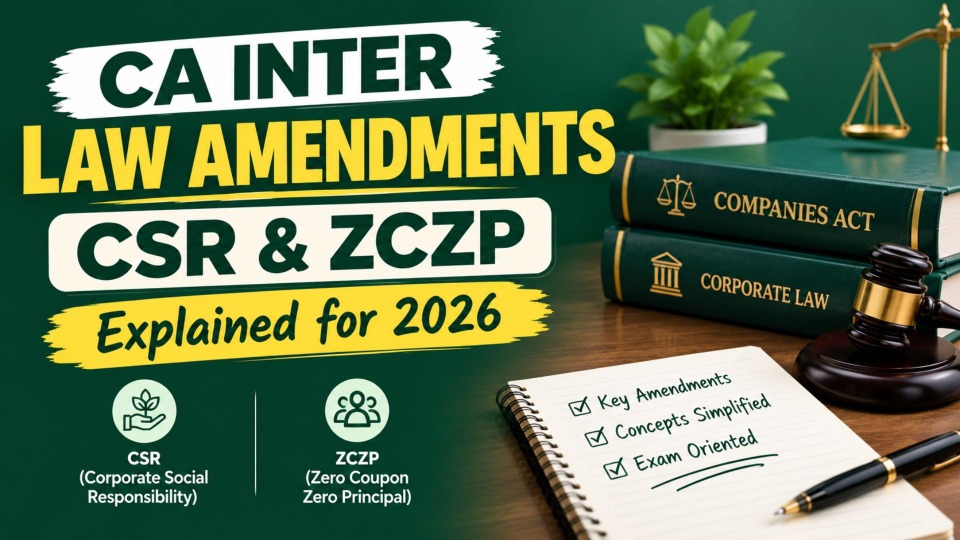
The CA Inter Law Amendments 2026 are relevant for students preparing for the Corporate and Other Laws paper. The amendments concerning Corporate Social Responsibility (CSR) and Zero Coupon Zero Principal (ZCZP) instruments highlight developments in corporate compliance and social-impact financing.
According to reports on the Companies (CSR Policy) Amendment Rules, 2026, eligible subscriptions to ZCZP instruments through the Social Stock Exchange may be recognised as an avenue for CSR contributions, subject to the applicable provisions.Students should focus on the eligibility criteria, prescribed limits, and compliance requirements associated with these amendments. Understanding the relevant provisions will help CA Intermediate aspirants prepare for amendment-based questions and develop a clearer understanding of their practical application.
A company's commitment to sustainable development and social welfare is known as corporate social responsibility, or CSR. Qualifying corporations are required to adhere to specific CSR spending and governance standards under Section 135 of the corporations Act, 2013.
Understanding the relevant thresholds, CSR Committee standards, CSR Policy, and reporting obligations are all part of CSR for CA Intermediate students. These ideas are pertinent to business compliance and company law.
The CA Inter Corporate and Other Laws 2026 syllabus and preparation guide, which lists key subjects and study techniques for Paper 2, can help students improve their readiness.
Zero Coupon Zero Principal is what ZCZP stands for. These financial instruments are intended to raise money for social impact initiatives without offering investors income or principle payback.
Subject to the relevant regulatory restrictions, eligible non-profit organizations (NPOs) may use ZCZP instruments through the Social Stock Exchange. Their main goal is to promote social activities rather than make money, in contrast to traditional financial investments.
An qualifying NPO might, for instance, raise money for a community development, healthcare, or education project. Subscribers donate money to support the stated goal without anticipating principal repayment.
The 2026 amendment is significant because it links CSR obligations with fundraising through eligible Zero Coupon Zero Principal (ZCZP) instruments. The key aspects to understand include:
The amendment notes mention a three-year period for utilising funds towards the specified social project, along with the transfer of unspent amounts to a Schedule VII fund. They also refer to exemptions from separate impact assessments and certain utilisation-reporting requirements.These conditions should be verified against the officially notified rules before being treated as definitive legal requirements. The treatment of unspent funds, the extent of reporting exemptions, and the specific eligibility criteria must be interpreted in accordance with the applicable notification.Companies should also review their CSR Policies and internal approval procedures to ensure compliance with any applicable amendments before subscribing to eligible ZCZP instruments.
In addition to CSR and ZCZP, students should stay up to date on pertinent changes to business legislation pertaining to electronic forms, disclosures in Board reports about maternity benefits and sexual harassment, and electronic filing of fraud reports using Form ADT-4.
The characteristics of ZCZP instruments should not be confused with these distinct compliance topics. It is important to independently confirm their applicability and effective dates.
In order to comprehend the structure of Paper 2 and organize their review, students getting ready for future attempts can also consult the CA Inter Corporate and Other Laws 2026–2027 syllabus, paper pattern, and preparation guide.
CSR and ZCZP are important topics for CA Intermediate Law preparation. Students should focus on the relevant provisions, eligibility criteria, compliance requirements and applicable amendments to build conceptual clarity and improve exam preparation.
CA Vipul Dhall is a first-attempt Chartered Accountant and All India Rank 43 in CA Finals, B.Com graduate from Hindu College, University of Delhi, he brings valuable corporate experience from PwC and Bharti Airtel, blending practical industry insights with a strong passion for teaching. With 6+ years of teaching experience, his mission is to inspire students to believe that the CA dream is achievable with the right guidance and discipline.
 Launch your Graphy