CA Intermediate Free Advanced Accounting Revision May 2026
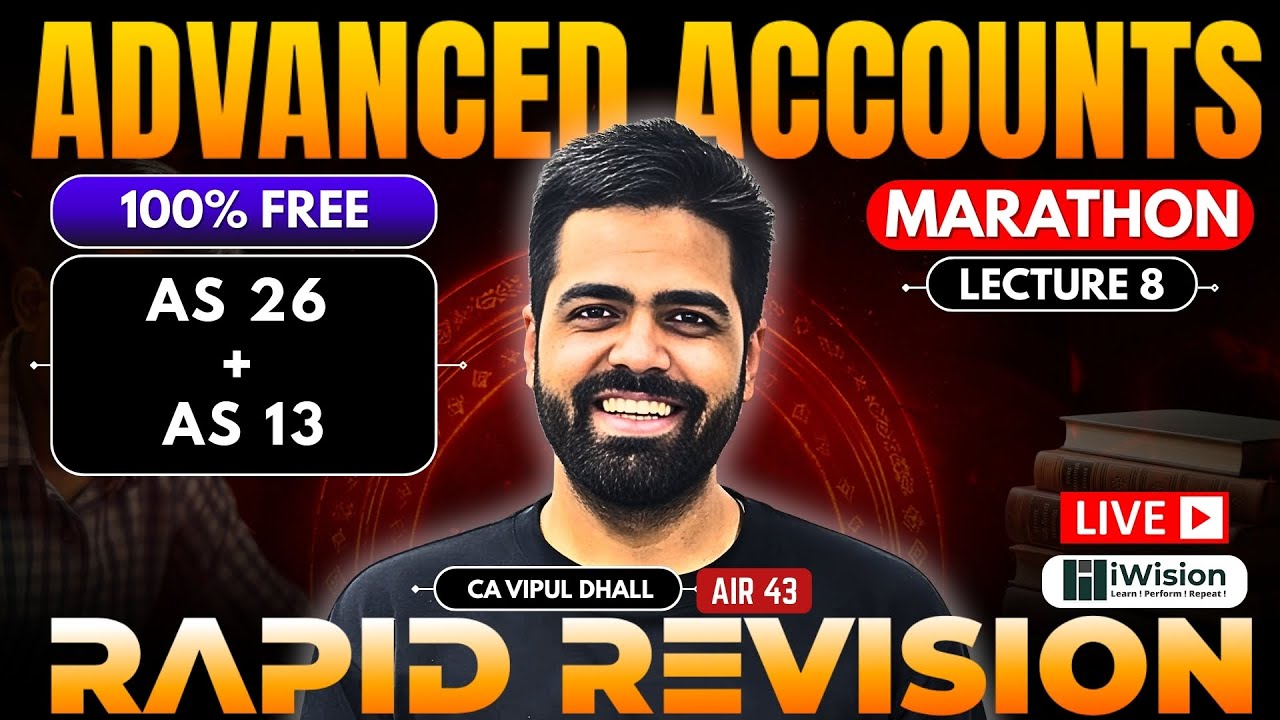
Preparing for the CA Intermediate Advanced Accounting paper under the ICAI New Scheme requires a blend of conceptual clarity and rigorous practice. Whether you are aiming for a basic pass or a prestigious Exemption (60+), focusing on high-weightage topics like Accounting Standards (AS) and Company Accounts is the most effective strategy. Based on the expert revision series by CA Vipul Dhall (AIR 43), this article breaks down the most critical chapters to help you rank #1 in your exams.
To score high, students should follow these topper-recommended steps:
1. AS 1: Disclosure of Accounting Policies
Fundamental Accounting Assumptions: Focuses on the fundamental accounting assumptions: Going Concern, Consistency, and Accrual.
Accounting Policies: Discusses the selection and disclosure of accounting policies, ensuring that financial statements represent a true and fair view.
Change in Accounting Policies: Highlights the requirement to disclose any change in accounting policies that has a material effect.
2. AS 18: Related Party Disclosures
Related Party: Parties are considered related if one party has the ability to control or exercise significant influence over the other in making financial and/or operating decisions.
Key Relationships: Holding companies, subsidiaries, fellow subsidiaries, associates, joint ventures, Key Management Personnel (KMP), and their relatives.
Disclosures Required: The name of the related party, nature of the relationship, and nature of transactions and outstanding balances.
3. AS 20: Earnings Per Share (EPS)
Basic EPS: Calculated by dividing the net profit or loss for the period attributable to equity shareholders by the weighted average number of equity shares outstanding during the period.
Diluted EPS: Adjusts the figures used in Basic EPS to take into account the effects of all dilutive potential equity shares (like convertible debentures or stock options).
Restatement: Requires restating EPS for prior periods in cases of bonus issues or share splits.
Core Coverage & Structure
The session is designed to simplify standards that students often find difficult due to the mix of theoretical concepts and practical applications.
1. AS 17: Segment Reporting
Definitions: Essential for understanding the criteria for segmentation.
Identifiable Reportable Segments: Identifying which segments must be reported separately based on specific thresholds (e.g., revenue, result, or assets) [07:05].
Business vs. Geographical Segments: Understanding the risks and returns associated with different business lines or locations.
2. AS 24: Discontinuing Operations
Discontinuing Operation Criteria: Focuses on the criteria for what constitutes a "discontinuing operation."
Disclosure and Presentation: Covers the timing of initial disclosure and how to present these operations in financial statements to provide users with a clear picture of future earning capacity.
3. AS 25: Interim Financial Reporting
Interim Financial Reporting: Explains the requirements for financial reports covering a period shorter than a full financial year.
Discrete vs. Integral Approach: Discusses the "Discrete" vs. "Integral" views of interim periods and the specific recognition and measurement principles applied.
1. AS 4: Events Occurring After the Balance Sheet Date
Adjusting Events: Events that provide additional evidence of conditions existing at the balance sheet date. These require adjustments to the assets and liabilities in the financial statements.
Non-Adjusting Events: Events occurring after the balance sheet date that do not relate to conditions existing at that date. These are typically disclosed in the report of the approving authority but do not require financial statement adjustments.
Exceptions: Covers specific cases like "Going Concern" issues discovered after the balance sheet date which must be treated as adjusting events.
2. AS 11: The Effects of Changes in Foreign Exchange Rates
Monetary vs. Non-Monetary Items: Crucial distinction for determining how to translate foreign currency items at the year-end.
Exchange Difference: How to calculate and recognize gains or losses arising from foreign currency transactions.
Foreign Operations: Guidance on translating the financial statements of integral and non-integral foreign operations.
Forward Exchange Contracts: Accounting treatment for contracts entered into for hedging or speculation.
1. AS 5: Net Profit or Loss, Prior Period Items & Accounting Policies
Ordinary vs. Extraordinary Items: Identifying items that arise from the ordinary activities of the enterprise versus those that are clearly distinct and not expected to recur frequently.
Prior Period Items: Correcting income or expenses that arise in the current period as a result of errors or omissions in the preparation of financial statements of one or more prior periods.
Changes in Accounting Estimates: Understanding that adjustments to estimates (like depreciation methods) are not prior period items but prospective changes.
Changes in Accounting Policies: Identifying when a change is necessary (e.g., for better presentation or law compliance) and the requirement for disclosure of its material effect.
2. AS 22: Accounting for Taxes on Income
Deferred Tax Assets (DTA) & Deferred Tax Liabilities (DTL): Explaining the core concept of "Timing Differences" between accounting income and taxable income.
Permanent vs. Timing Differences: Distinguishing between items that will never reverse (permanent) and those that will (timing).
Recognition Criteria: Applying the "Prudence" principle, especially for DTA, which requires reasonable or virtual certainty of future taxable income.
Current Tax: Calculating the amount of income tax determined in accordance with the tax laws.
1. AS 2: Valuation of Inventories
The mentor divides this standard into four distinct parts for easier comprehension:
Meaning of Inventory: Assets held for sale in the ordinary course of business, in the process of production for such sale, or in the form of materials/supplies to be consumed in the production process or rendering of services [05:16].
Measurement: Inventories are valued at the lower of cost and net realizable value (NRV).
Methods of Determination: Discusses cost formulas like FIFO or Weighted Average, and techniques such as the Retail Method or Standard Costing.
Disclosure: Requirements for disclosing accounting policies and the total carrying amount of inventories.
2. AS 10: Property, Plant, and Equipment (PPE)
As one of the largest standards, the revision focuses on:
Recognition Criteria: PPE is recognized if it is probable that future economic benefits will flow to the enterprise and the cost can be measured reliably.
Measurement at Recognition: Includes purchase price, import duties, and directly attributable costs to bring the asset to its working condition.
Subsequent Measurement: Organizations can choose between the Cost Model and the Revaluation Model.
Depreciation & Derecognition: Guidelines on the systematic allocation of the depreciable amount and removing an item from the balance sheet upon disposal.
1. AS 13: Accounting for Investments
The standard focuses on how an enterprise should account for investments held for the purpose of earning income.
Purpose of Investment: Includes earning income through dividends, interest, and rentals, or for capital appreciation [07:22].
Current Investments: Investments that are by their nature readily realizable and are intended to be held for not more than one year. These are valued at the lower of cost and fair value.
Long-term Investments: Investments other than current investments. These are usually carried at cost, with provisions made only for permanent declines in value.
Investment Property: Also covered under AS 13 if held to earn rentals rather than for use in the production or supply of goods [07:42].
AS 26: Intangible Assets
Recognition Criteria: An intangible asset should be recognized if it is probable that future economic benefits will flow to the enterprise and the cost can be measured reliably.
Internally Generated Assets: Specific guidance on research phase (expensed) vs. development phase (capitalized if criteria are met).
Amortization: The systematic allocation of the depreciable amount of an intangible asset over its useful life.
Accounting Standards Deep Dive
1. AS 16: Borrowing Costs
Borrowing costs are interest and other costs incurred by an enterprise in connection with the borrowing of funds
Qualifying Asset: An asset that necessarily takes a substantial period of time to get ready for its intended use or sale. Examples include manufacturing plants, power generation facilities, and investment properties.
Recognition: Borrowing costs directly attributable to the acquisition, construction, or production of a qualifying asset should be capitalized. Other borrowing costs are recognized as an expense in the period they are incurred.
Commencement & Cessation: Capitalization begins when expenditures/borrowing costs are being incurred and activities to prepare the asset are in progress. It ceases when substantially all activities necessary to prepare the qualifying asset are complete.
2. AS 19: Leases
This standard prescribes appropriate accounting policies and disclosures for both Finance and Operating leases.
Finance Lease: A lease that transfers substantially all the risks and rewards incidental to ownership of an asset. Title may or may not eventually be transferred.
Operating Lease: Any lease other than a finance lease. Rental income/expense is usually recognized on a straight-line basis over the lease term.
Sale and Leaseback: Transactions where the owner sells an asset and immediately leases it back from the buyer. The accounting depends on whether the leaseback is a finance or operating lease and if the sale price is at fair value.
1. AS 28: Impairment of Assets
This standard ensures that an enterprise's assets are carried at no more than their recoverable amount.
Core Concept: An asset is impaired when its carrying amount exceeds its recoverable amount.
Recoverable Amount: The higher of an asset's Net Selling Price and its Value in Use.
Value in Use: The present value of estimated future cash flows expected to arise from the continuing use of an asset and from its disposal at the end of its useful life.
Recognition of Impairment Loss: An impairment loss should be recognized as an expense in the profit and loss statement immediately, unless the asset is carried at a revalued amount.
2. Buy Back of Securities
The revision covers the legal and accounting framework for a company purchasing its own shares.
Sources of Buy Back: Can be out of free reserves, securities premium account, or the proceeds of a fresh issue of shares/securities.
Must be authorized by the Articles of Association (AOA).
Requires a special resolution ( unless buy-back is 10% or less of total paid-up equity capital and free reserves
Debt-equity ratio post buy-back should should not exceed 2:1
Accounting Treatment: Includes the creation of a Capital Redemption Reserve (CRR) if the buy-back is out of free reserves or securities premium.
1. AS 7: Construction Contracts
This standard is highly favored by the ICAI for both practical questions and case-based MCQs.
Percentage of Completion Method (POCM): Revenue and expenses are recognized by reference to the stage of completion of the contract activity at the reporting date.
Contract Revenue: Includes the initial amount agreed upon plus variations, claims, and incentive payments to the extent they are probable and can be reliably measured.
Contract Costs: Comprises costs directly related to the specific contract, costs attributable to contract activity in general (allocated), and other costs specifically chargeable to the customer.
Recognition of Expected Losses: If it is probable that total contract costs will exceed total contract revenue, the expected loss is recognized as an expense immediately.
2. AS 9: Revenue Recognition
This standard explains when revenue arising from the ordinary activities of an enterprise should be recognized in the profit and loss statement
Sale of Goods: Revenue is recognized when the seller has transferred the significant risks and rewards of ownership to the buyer.
Rendering of Services: Revenue is recognized either by the Percentage of Completion method or the Completed Service Contract method.
Interest: Recognized on a time proportion basis.
Royalties: Recognized on an accrual basis in accordance with the terms of the relevant agreement.
Dividends: Recognized when the owner's right to receive payment is established.
1. AS 21: Consolidated Financial Statements
This standard is applied in the preparation and presentation of consolidated financial statements for a group of enterprises under the control of a parent.
Control: The power to govern the financial and operating policies of an enterprise so as to obtain benefits from its activities.
Consolidation Procedures:
Combining like items of assets, liabilities, income, and expenses.
Eliminating the cost to the parent of its investment in each subsidiary and the parent's portion of equity of each subsidiary.
Calculating Minority Interest (the part of the net results of operations and of net assets of a subsidiary attributable to interests which are not owned, directly or indirectly through subsidiaries, by the parent).
2. AS 23: Accounting for Investments in Associates
Applied in accounting for investments in associates in the preparation and presentation of consolidated financial statements by an investor.
Associate: An enterprise in which the investor has significant influence and which is neither a subsidiary nor a joint venture of the investor.
Equity Method: The investment is initially recorded at cost and adjusted thereafter for the post-acquisition change in the investor's share of net assets of the investee.
3. AS 27: Interests in Joint Ventures
Applies to accounting for interests in joint ventures and the reporting of joint venture assets, liabilities, income, and expenses in the financial statements of venturers and investors.
Joint Venture: A contractual arrangement whereby two or more parties undertake an economic activity, which is subject to joint control.
Proportionate Consolidation: A method of accounting and reporting whereby a venturer’s share of each of the assets, liabilities, income, and expenses of a jointly controlled entity is combined on a line-by-line basis with similar items in the venturer’s financial statements.
Core Concept: What is Internal Reconstruction?
Internal reconstruction involves the reorganization of a company's financial structure without winding up the existing company. It is typically resorted to when a company has accumulated heavy losses and its assets are overvalued. The reorganization is achieved through three main elements:
1. Revaluation of Assets: Bringing assets down to their true fair value.
2. Reassessment of Liabilities: Negotiating with creditors and debenture holders to reduce or waive their claims.
3.Reduction of Paid-up Capital: Reducing the face value or paid-up amount of shares to write off accumulated losses.
Branch Accounting Framework
The session begins with a "Master Chart" that categorizes branches into two primary types:
1. Domestic Branches Located outside the home territory, requiring the translation of financial statements into the home currency.
Integral Foreign Operations: Operates as an extension of the HO’s operations.
Non-Integral Foreign Operations: Operates with a significant degree of autonomy.
Accounting Treatment: Follows AS 11 for translating monetary and non-monetary items and recognizing exchange differences.
Conclusion
Mastering CA Intermediate Advanced Accounting is not just about memorizing formats; it’s about understanding the core logic behind every Accounting Standard and adjustment. By focusing on AS 12, AS 14, and Schedule III compliance, you lay a strong foundation for an exemption-grade score. Stay consistent with your revision, follow the ICAI Study Material, and leverage expert guidance to turn your CA dream into reality for the May 2026 exams.
Frequently Asked Questions (FAQs)
Q1. Is the ICAI New Scheme applicable for Jan/May 2026 attempts?
Yes, the Jan 2026 and May 2026 exams strictly follow the ICAI New Scheme. This revision guide and all linked courses by CA Vipul Dhall (AIR 43) are fully updated with the latest syllabus, including all new accounting standards weightage.
Q2. How can I score an exemption (60+) in advanced accounting?
To secure an exemption, prioritize high-yield chapters like AS 12, AS 14, and Schedule III Financial Statements. Focus on presentation, quote correct accounting standardsnumbers, and practice every question from the iWision Practice Manual.
Q3. Why is AS 3 Cash Flow Statement critical for the exam?
AS 3 (Cash Flow Statement) is a staple in CA Inter exams. Mastering the indirect method for operating activities is essential.
Q4. Are these revision videos enough for a complete syllabus brush-up?
The Rapid Revision series is designed for fast conceptual clarity and covering "star adjustments" from the ICAI study material.
Q5. Where can I find the notes for this Advanced Accounting revision?
Comprehensive revision notes and the iWision Practice Manual are available on the official CA Classes portal.
Mentor Card
Meet Your Mentor
CA Vipul Dhall
CA Vipul Dhall is a first-attempt Chartered Accountant and All India Rank 43 in CA Finals,
B.Com graduate from Hindu College, University of Delhi, he brings valuable corporate
experience from PwC and Bharti Airtel, blending practical industry insights with a strong
passion for teaching. With 6+ years of teaching experience, his mission is to inspire
students to believe that the CA dream is achievable with the right guidance and discipline.














 Launch your Graphy