
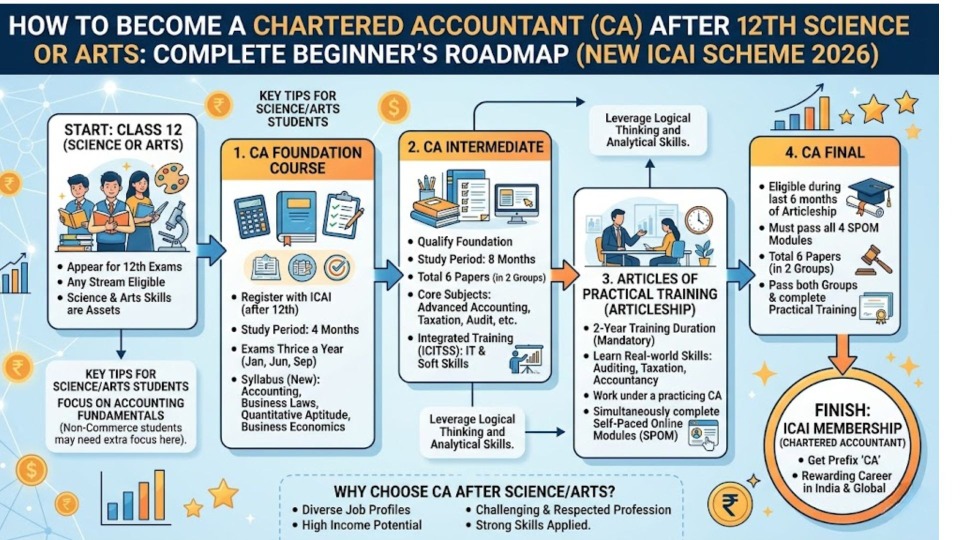
How to Become a CA After 12th Science or Arts: A Complete Roadmap for Beginners

There is a very common myth among students and parents that Chartered Accountancy (CA) is a career path reserved only for those who studied Commerce in Class 11 and 12. But let’s clear the air right at the start: This is absolutely false.
Whether you are from a Science background (PCM/PCB) or an Arts background, the doors of the Institute of Chartered Accountants of India (ICAI) are wide open for you. In fact, many of the most successful CAs and even some All India Rank holders started their journeys as Science or Arts students.
In this detailed guide, we will break down every single aspect of becoming a CA if you are from a non-commerce stream. We will discuss the entry routes, the syllabus, the challenges, and the strategies to succeed.

CA Final May 2026 Courses

🚀 Enrol Now for CA Foundation May 2026 Courses

Click on any batch to view details and enrol instantly!

Why Choose CA After Science or Arts?

You might wonder, "If I studied Science or Arts, why should I switch to CA?" Here are a few reasons why this switch is a great idea:

  • Global Recognition: The CA degree is respected worldwide. It’s a professional qualification that carries immense prestige.
  • Career Versatility: A CA doesn't just do "accounting." They work in taxation, auditing, corporate finance, investment banking, and even consultancy.
  • Logic-Based Learning: Science students often have strong analytical and logical skills. Since Accounting is based on logic rather than just memorization, many non-commerce students find they are naturally good at it.
  • Cost-Effective: Compared to an MBA or a private engineering degree, the cost of becoming a CA is very low, while the return on investment (salary) is very high.

The Eligibility Criteria: Can I Really Apply?

Yes! According to ICAI guidelines, there is no restriction based on your stream in 12th grade.

  1. For the Foundation Route: You just need to pass your Class 12 exams from any recognized board (CBSE, ICSE, or State Boards).
  2. For the Direct Entry Route: If you have already graduated in Science or Arts, you can skip the first level (Foundation) and jump directly to Intermediate, provided you meet the percentage criteria (usually 60% for non-commerce graduates).

Path 1: The CA Foundation Route (After Class 12)

This is the most common path. If you have just finished school, here is the step-by-step roadmap

Step 1: Registration with ICAI

After passing your Class 10th exams, you can provisionally register for the CA Foundation course. However, you can only sit for the exam after appearing for your Class 12th exams.

Step 2: The 4-Month Study Period

ICAI requires you to complete a mandatory 4-month study period after registration. During this time, you prepare for the four papers of the Foundation level.

Step 3: Clearing the Foundation Exam

The Foundation exam consists of four papers

  • Paper 1: Accounting (Subjective)
  • Paper 2: Business Laws (Subjective)
  • Paper 3: Quantitative Aptitude (Maths, Stats, LR - Objective)
  • Paper 4: Business Economics (Objective)

Step 4: CA Intermediate

Once you pass Foundation, you enter the "Inter" level. This level has 6 papers divided into two groups. You have to study for 8 months before you can appear for these exams.

Step 5: ICITSS Training

Before you start your practical training (Articleship), you must complete a 4-week training called ICITSS. This covers Information Technology and Soft Skills (communication, personality development, etc.).

Step 6: Articleship (Practical Training)

This is the most crucial part of the CA journey. You will work under a practicing Chartered Accountant for 2 years. You get to learn how the corporate world works, how to file taxes, and how to conduct audits. You also get a monthly "stipend" (salary) during this time.

Step 7: CA Final - The Last Frontier

After completing your articleship and passing both groups of Intermediate, you reach the Final level. After clearing 6 papers and some self-paced online modules, you are officially a Chartered Accountant!

Path 2: The Direct Entry Route (For Graduates)

If you have already completed a B.Sc., B.A., B.Tech, or any other degree, you don't need to give the Foundation exam.

  • Criteria for Non-Commerce Graduates: You must have scored at least 60% marks in your graduation or post-graduation.
  • The Process: You register directly for CA Intermediate, complete your ICITSS training, and then you can start your articleship and appear for exams.

The Challenges for Non-Commerce Students (And How to Beat Them)

Let's be honest—switching streams is not a walk in the park. You will face some unique challenges:

1. The "Fear of the Unknown" (Accounting)

Commerce students have been studying "Debit" and "Credit" for two years (Class 11 and 12). For you, this is brand new

  • The Solution: Start from the very basics. Don't try to solve complex problems on day one. Pick up a Class 11 Accountancy book or join a "Bridge Course" designed for non-commerce students. Once the "Golden Rules of Accounting" are clear, you will be on par with any commerce student.

2. Understanding Business Laws

Science students are used to formulas and facts, while Arts students are used to theory. Law is a mix of both—it requires logic and precise writing

  • The Solution: Read the ICAI study material carefully. Practice writing answers instead of just reading them. Understanding the "why" behind a law makes it much easier to remember.

3. Jargon/Terminology

Words like "Amortization," "Depreciation," "Consolidation," and "Dividend" might sound like a foreign language initially.

  • The Solution: Keep a small dictionary or use Google to look up terms as you encounter them. Within a month, these words will become part of your daily vocabulary.

Study Strategy: How to Plan Your Journey

To pass CA on the first attempt as a non-commerce student, you need a solid plan:

  • Focus on Conceptual Clarity: In Science, you don't just memorize a formula; you understand the derivation. Apply the same logic to CA. Don't memorize entries—understand the transaction.
  • Make a Realistic Timetable: CA requires consistency. Instead of studying for 15 hours one day and 0 hours the next, try to put in a steady 6-8 hours daily.
  • Practice with ICAI Material: The study modules provided by ICAI are your "Bible." Ensure you solve all the illustrations and back-questions.
  • Take Mock Tests: Especially for objective papers (Maths and Economics), speed is key. Solving previous year papers will build your confidence.
  • Join a Mentor-Led Program: Since you are new to the field, having a mentor or teacher who can guide you through the basics is invaluable. Online classes are great because you can watch the basic lectures multiple times until you understand them.
Mentor Card
Meet Your Mentor

CA Vipul Dhall

CA Vipul Dhall is a first-attempt Chartered Accountant and All India Rank 43 in CA Finals, B.Com graduate from Hindu College, University of Delhi, he brings valuable corporate experience from PwC and Bharti Airtel, blending practical industry insights with a strong passion for teaching. With 6+ years of teaching experience, his mission is to inspire students to believe that the CA dream is achievable with the right guidance and discipline.

AIR 43
6+ Years
Explore my courses

Do you have Any query?

WhatsApp us